
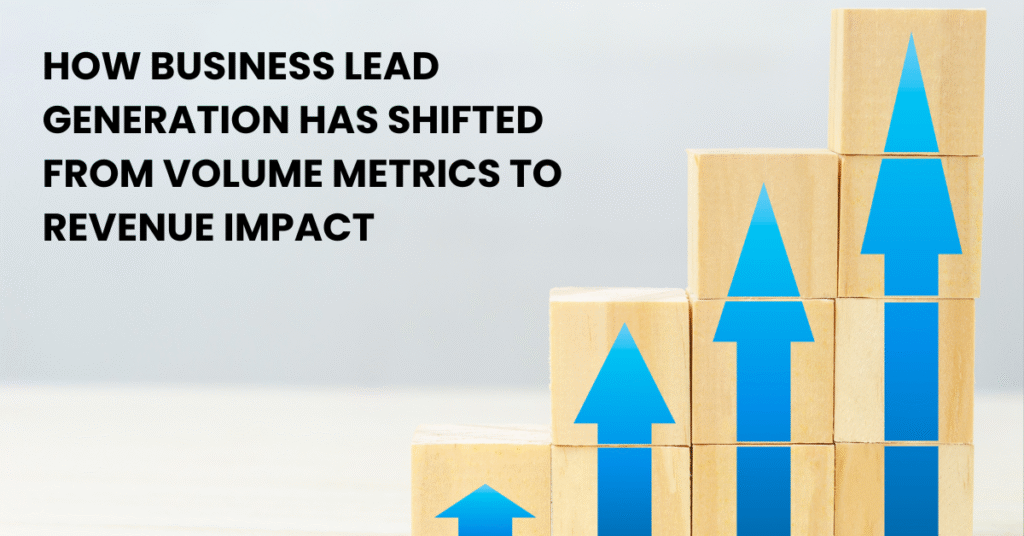
For years, business lead generation remained a number game. The number of leads determines the success of a marketing campaign. However, gradually, buyer journeys became more complex. Budgets got cramped. As a result, business owners started asking some obvious questions – how many of the leads generated are converting?
In today’s competitive business environment, lead generation has shifted from merely counting numbers to measuring its impact. Let us explore some ways this shift has happened.
1. Not About More Leads But the Right Ones
Conventional lead generation was about quantity. Modern lead-gen is about quality. Factors such as Ideal Customer Profiles, intent signals and firmographic filters drive campaigns. Hence, leads aligned with these aspects, even if few, matter. Businesses consider them productive given their potential to convert into sales.
2. Revenue-Centric Metrics, Not Vanity Metrics
Earlier, performance reviews were primarily focused on impressions, clicks, and raw lead counts. These parameters still matter. But they do so only for surface-level insights. They seldom correlate with revenue. Today, businesses track and measure various revenue-centric metrics. Some common ones include pipeline contribution, revenue attribution, customer acquisition cost and lifetime value. Thus, businesses don’t track marketing in isolation. The foremost measure is conversions and subsequent revenue generation.
3. Focusing on the Buying Committee. Not the Lead
Traditional lead-generation models focused solely on the lead. It is because the B2B ecosystem wasn’t as complicated earlier. However, modern B2B involves multiple stakeholders and decision-makers. Thus, the lead and decision-maker may be different.
Accordingly, lead generation has moved to Account-Based Experience. So, instead of pursuing a single person, marketers target the entire network of influencers.
That’s obvious for reasons. A crucial one includes how deeply an organization has penetrated the decision-making team of a company. Merely counting the number of contacts acquired doesn’t qualify as a productive parameter.
4. Predictive Lead Scoring, Not Static
Earlier, lead scoring was based on basic actions such as downloading whitepapers, opening or responding to emails. These parameters are still relevant. But the models on which they were based were usually rigid and inaccurate.
However, businesses are now using AI-powered and behavior-driven lead scoring. These analyze numerous touchpoints such as buying signals, engagement depth and historical conversion data. Predictive models are intelligently programmed to prioritize leads with the highest conversion potential. Such smart, tech-driven shifts provide clarity to sales teams. As a result, they focus on leads that matter.
Work with Demand Fluence, a performance driven partner among modern business lead generation companies, to generate leads that truly convert
5. Sales and Marketing Alignment has Become Imperative
Those days when marketing threw leads on the wall, and sales decided what to chase are long gone. That was the era of volume-based lead generation. Thankfully, it has faded away. That’s because it signified a disconnected approach. It would usually result in leads wasted and efforts going down the drain. Let alone blame games!
Revenue-oriented lead generation focuses on measurable productivity. Therefore, it demands tight alignment between sales, marketing and revenue operations. Both teams share the same definition of leads. They review pipelines collaboratively and have integrated tech stacks that ensure efficient lead nurturing and conversions.
6. Content Influences Buying Decisions
Content strategies in the past usually focused on top-of-the-funnel awareness. They generated traffic, but without the buying intent.
However, the game has changed now. Content has become more value-driven and relevant. Today, companies create content mapped across the buyer’s journey. So, those in the initial stage will interact with basic awareness content. On the other hand, leads in the final stage will look at content that drives decisions.
Businesses now create content that provides actionable insights and value. It includes case studies, comprehensive product comparisons, ROI calculators, and solution-driven thought leadership content. Each of these content pieces focuses on moving prospects towards the buying decision. Merely engagement isn’t considered productive these days.
7. Looking at Business Lead Generation as a Long-Term Growth Engine
B2B buying journeys are lengthy. They demand you to be a marathon runner, not a sprinter. Many companies that earlier focused on short-term demand lever are stepping out of a sprint mindset. They are now aligning themselves with the current dynamics of the lead generation game. Essentially, they are treating lead generation as a strategic revenue engine. Some strategies they are implementing include account-based marketing, nurture programs and customer expansion strategies.
Want to Drive the Vital Shift in Business Lead Generation?
Demand Fluence is here to help. We are one of the trusted business lead generation companies with years of experience, helping businesses generate and convert leads.
Our experts don’t just focus on campaign creation. Instead, they reshape your lead-gen ecosystem, driving approach shifts that let you stay ahead of your competition. Thus, you generate better leads, chase leads that matter and augment your conversion rates.
So, whether you’re a SaaS company or a B2B manufacturer, we’ve got you covered. Connect with us at hi@demandfluence.com and begin your fruitful journey with us.